I don't decorate. I collect evidence.
Every object on this étagère has a story — and not a vague, 'oh I found it at a market' kind of story. I mean a real one. The kind that makes you stop mid-conversation and say, wait, tell me more. That is, actually, the entire point.
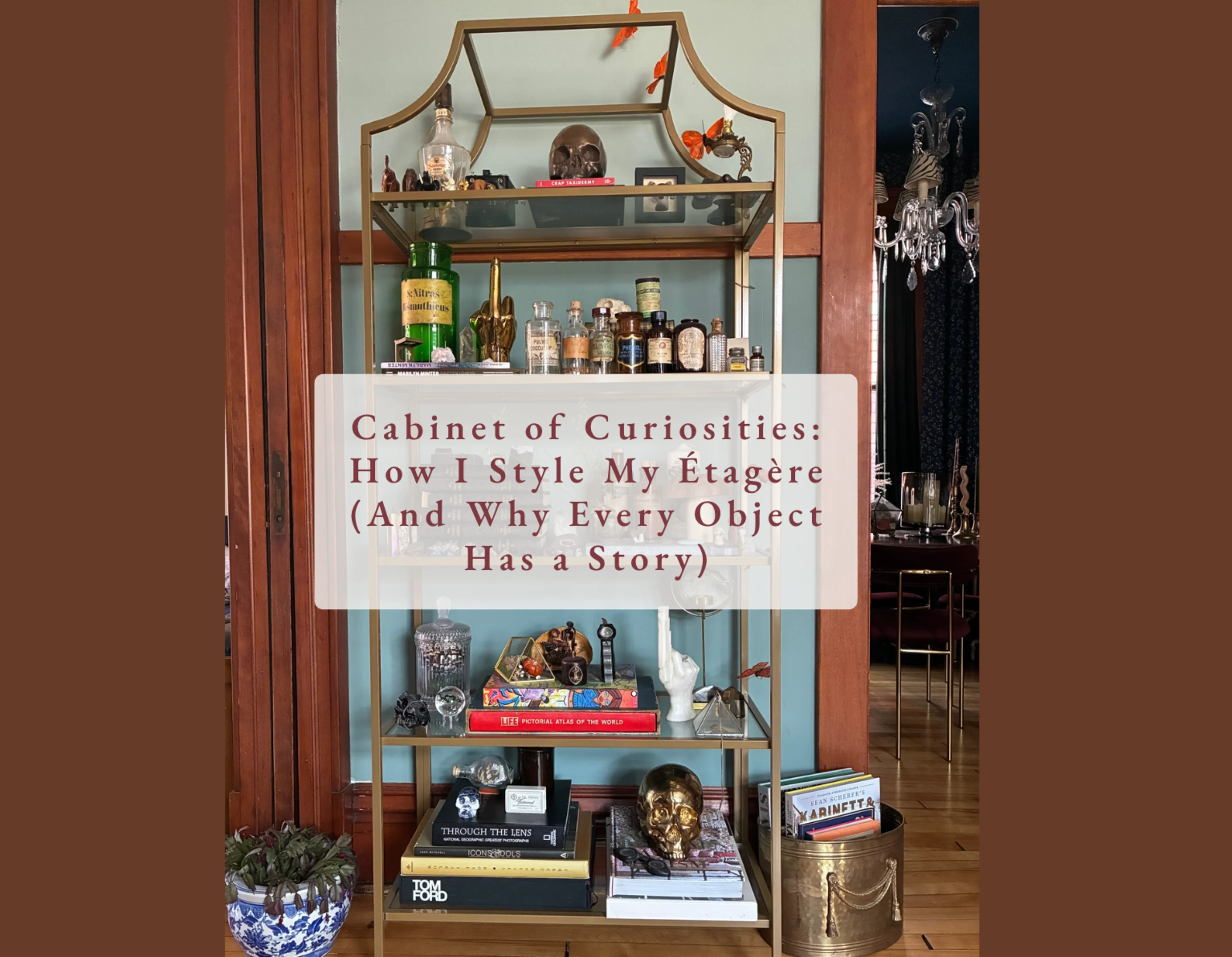
This is my cabinet of curiosities. And before you assume that's just a fancy name for a chaotic shelf, let me explain. The cabinet of curiosities — or Wunderkammer — was a Renaissance-era tradition: a room or cabinet filled with extraordinary objects from across the natural world, history, and human experience. Explorers, scientists, and collectors kept them as a way of making sense of a vast, strange world. I think about my étagère the same way. It's not styled. It's curated. There's a difference.
The rule is simple: if an object doesn't have a story — or spark curiosity about one — it doesn't earn a spot. Here's a shelf-by-shelf tour of everything you see, and where it all came from.
The Top Shelf: The Bones of It All


Let's start at the beginning — literally. The bronze skull was one of the very first pieces I added to this collection. I lived in San Francisco for 16 years before relocating to Minnesota, and just around the corner from our apartment there was an interior designer's studio. I went there almost every week. He was deeply well-traveled and always had the most extraordinary things. The skull came from him, and so did the large green apothecary bottle you'll see on the shelf below. He was the spark that lit this whole thing.
The elephants are a 20-year collection and probably my most layered story on this shelf. One was purchased on our honeymoon in Bosnia — my husband and I have been together long enough that some of these objects have witnessed our whole relationship. Others have been gifted to us over the years by friends and family who know we collect them. Every elephant has a different origin, a different material, a different person attached to it.
The Brownie camera was a gift for my husband, who is an avid photographer — a nod to where photography began. Next to it, the Samovar Vodka bottle was sourced from Loft Antiques a couple of years ago. The glass piece on the far right — the ornate brass and glass lamp — came from Paxton Gate in San Francisco, one of my absolute favorite shops for exactly this kind of object.
The butterfly specimens you see here (and scattered throughout the étagère) have been collected over years from various shops in San Francisco and through Etsy and eBay. I've always been drawn to butterflies — they're one of my recurring motifs. The framed mushroom print in the shadow box came from the same designer's studio in San Francisco. The 'Crap Taxidermy' book was gifted to us, and 'Vinegar Mirror' came from an art gallery in SF. Even the books have provenance.
The Second Shelf: The Apothecary

This is the shelf people always want to talk about — and for good reason. It starts with the magnifying loupe on the left, which is actually where this entire collection began. I purchased it from eBay 16 years ago, and something about it — the weight of it, the specificity of it, the question of who used it and for what — set me on a path I haven't veered from since.
The large green apothecary jar labeled 'S. Nitras Bismuthicus' also came from that designer's studio in San Francisco. Bismuth nitrate was used in 19th-century medicine, and that label is original. I don't know exactly where it was sourced before it came to us, which, honestly, makes it even better.
The brass middle finger came from an estate sale about two years ago. It arrived with absolutely no context and I love it for that. The books stacked on this shelf are Marilyn Minter's monographs — she's one of my favorite artists and those were purchased about five years ago. The small crystal quartz pieces were collected across multiple years and locations.
The apothecary bottles are a mix: many came from that SF designer's studio, some were gifted. The Phenol bottle — the dark one labeled 'Acid Phenylic, Acid Carbolic' — was purchased from a remarkable medical antiques shop in Amsterdam on our honeymoon. Getting that bottle through customs was no easy feat. Worth every anxious moment of it. Also from that same shop: a memento mori and hand, foot, and skull drawings dating back to the 1800s. The animal skull on this shelf came from Paxton Gate in San Francisco.
And then there's the glass eye. Tucked on this shelf, easy to miss at first glance — it belonged to my husband's grandfather. Of every single object in this cabinet, that one carries the most weight. It's not vintage. It's not sourced. It's just his. That's the whole story, and it's enough.
The Third Shelf: The Library


The stack of black embossed volumes — The Master Library series — were actually centerpieces at our wedding. We purchased them for the tables and afterward they came home with us, which feels like exactly the right ending for a set of books.
The crystals and geodes scattered across the lower shelves have been collected over the last decade: some from our honeymoon in Amsterdam, some from Sedona, Arizona, and some from local shops in Minneapolis, Stillwater, and San Francisco. The iridescent crystal tower on the far left is one of my favorites.
The architect's scale — and this is one of my favorite stories on this entire étagère — starts with a son and ends with airport security. We found an extraordinary oddities shop in Amsterdam, run by a young guy with the most remarkable taxidermy we'd ever seen in one place. We desperately wanted pieces. When he explained he couldn't sell them for export, I told him I knew people who'd listed taxidermy on customs forms as 'stuffed animals' and gotten away with it. He did not budge. The son, sensing our obsession with all things strange and beautiful, sent us to his parents' shop around the corner — a medical antiques dealer where we found the Phenol bottle, the memento mori, and the hand, foot, and skull drawings from the 1800s. The architect's scale also came from there: a London architect's tool from the 1700s. When we left Amsterdam for Ireland, security at the Amsterdam airport kept picking it up, turning it over, comparing edges, passing it to colleagues. It made it through. It now sits on a shelf in Saint Paul looking completely innocent, which it absolutely is not.
The book 'Moon: Ancient Skies, Ancient Trees' by Beth Moon was purchased at her art show in San Francisco. The other apothecary bottles on this level were thrifted and gifted over the years. The wooden mushroom came from Loft Antiques.
The Fourth Shelf: Houston, Art, and Gifted Things

The large colorful book at the center of this shelf is a Houston rap photography book — and it was purchased at a book signing in Houston, where I'm from. Bun B and the photographer both signed it, along with Bun B's coloring book. That one makes me happy every time I see it.
The terrarium on this shelf? I made that. It's one of my favorite things to do — building small worlds inside glass. The glass jar, the mushroom piece, the candle, and the Life Atlas book were all gifted to us. The candle holder was also a gift. The hand holding a gun candle — purchased at the same estate sale as the brass middle finger on the shelf above — is one of those objects that stops guests mid-sentence.
The black skull with chain was purchased at an art fair here in Saint Paul. The hand crank flashlight — which still works, by the way — came from Jay Jeffers' shop in San Francisco, a designer I've long admired.
The Bottom Shelf: Books, Skulls, and a Ship in a Bottle
The bottom shelf is where the big coffee table books live alongside a few of my most-asked-about objects. The ship in a bottle came from Goodwill in San Francisco — we lived next door. The blue skull is hand-carved lapis lazuli, which makes it as much a geological specimen as a sculptural one — it came from an estate sale, as did the Tom Ford book, the Rose Tarlow book, and the Maximalism book. That same estate sale also yielded the brass middle finger on the second shelf and the gun candle on the fourth. One estate sale, three shelves of stories. That's a good afternoon.
The 'Through the Lens' National Geographic book and 'Icons & Idols' were gifted to us. The mini cards came from that interior design studio in SF — the place that started so much of this collection. The magnifying glasses were sourced from Etsy. 'The Decisive Moment' was purchased as a gift for my husband, the photographer.
The gold skull on the right? That one is the single mystery. I genuinely cannot remember where it came from — which makes it the only object on this entire étagère without a story I can tell you. Maybe that's fitting. Every cabinet of curiosities should have at least one unanswered question.
The Philosophy Behind It All
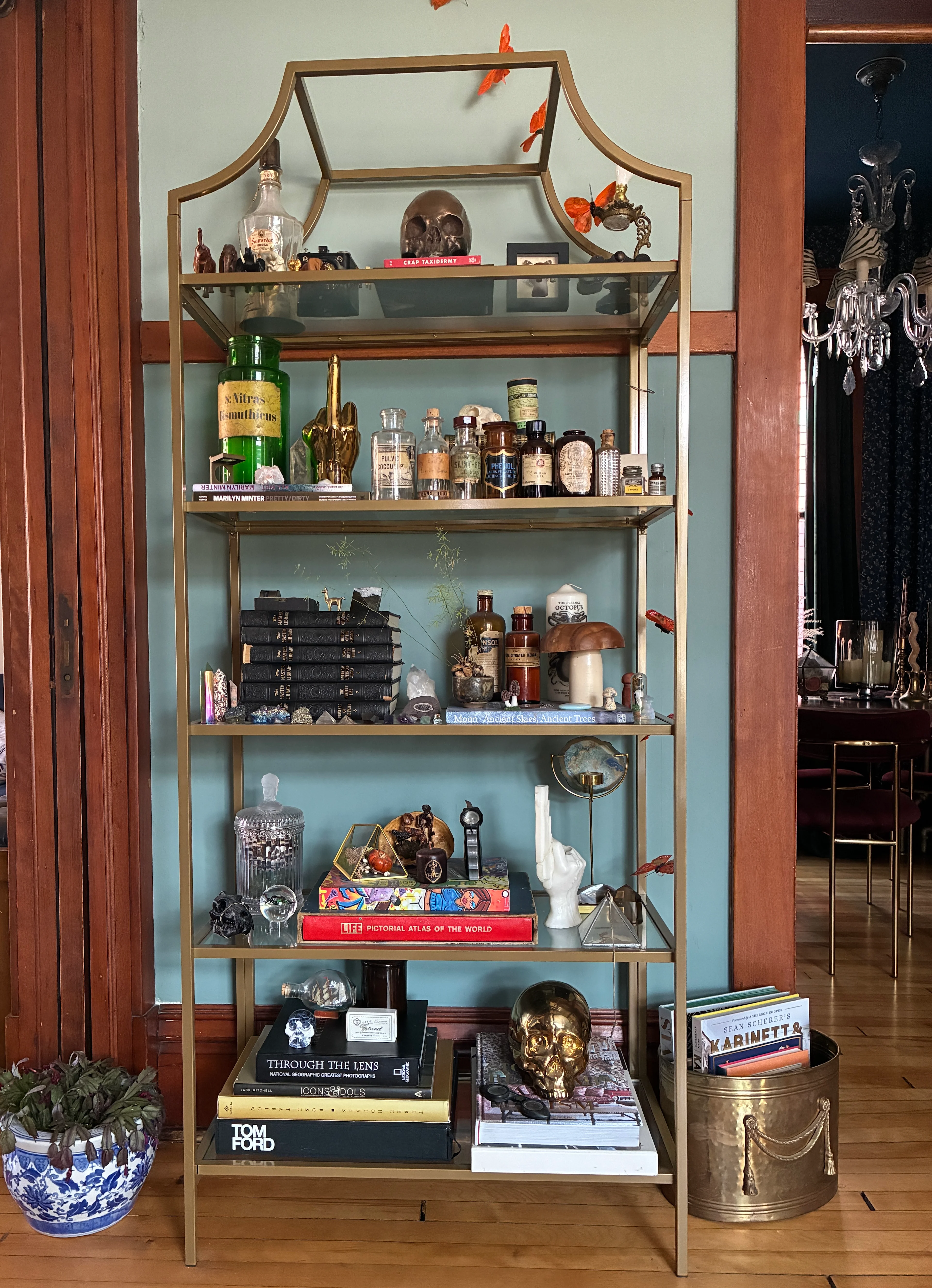
The reason this étagère works isn't the étagère itself — it's a fairly simple brass and glass piece. It works because every object on it has been chosen with intention. Not for aesthetics alone, but for meaning. For memory. For the question it raises.
When I work with clients, this is the framework I bring to their spaces too. Objects that have been collected — bought on a honeymoon, inherited from a family member, found at an oddities shop in Amsterdam, thrifted from the shop next door — create rooms that feel genuinely inhabited. Not designed. Lived in.
That's the difference between a room that photographs well and a room that makes you feel something. One is curated. The other is decorated. I know which one I'm going for.